News & Events

Colloquium: Hyperdoping Silicon for Infrared Optoelectronics

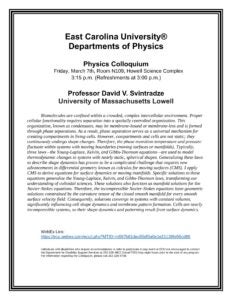
7 April 2026 — This Friday, April 10 at 3:15 p.m. will feature Professor Jay Mathews from the University of North Carolina – Charlotte, where he will present Hyperdoping Silicon for Infrared Optoelectronics:

Silicon is the basis for a multi-billion-dollar industry, but its optical properties have limited its use in optoelectronics for infrared (IR) applications. Many IR devices are currently made using III-V or II-VI materials, which has served to fill the gap, but these materials tend to be expensive, and integrating the materials and devices into Si fabrication can be difficult. Recent advances in the field of laser hyperdoping have produced a new class of materials that could lead the way to silicon-based, CMOS-compatible infrared detectors. Using the method of ion implantation followed by pulsed laser melting (II-PLM), silicon films with impurities at concentrations well above the solid solubility limit (hyperdoped) can be fabricated, achieving the necessary concentrations to form intermediate bands (IBs). IBs can be used to induce sub-band gap optical absorption in semiconductor materials, and this effect can be exploited for photodetection. Recent work has centered around Si:Au, from which prototype IR detectors with response at wavelengths up to 2 microns have been successfully fabricated. I will discuss the fabrication of these new materials, their optical and structural properties, and our recent work on photodetector development.

The presentation will be held in room N109 of the Howell Science Complex. Please join us via Webex if you are unable to attend in person.
Colloquium: At the Crossroads of Physics and Biology – Interesting Ideas in Microscopy and Understanding Cell Migration

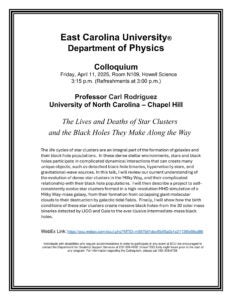
25 March 2026 — Tomorrow, 3/26, at 3:15 p.m. will feature Dr. Daniel Dziob from the Jagiellonian University in Krakow, Poland, where he will present At the Crossroads of Physics and Biology: Interesting Ideas in Microscopy and Understanding Cell Migration:

Microscopy is one of the areas where physics meets biology. Physics enables the development of new ways to observe and describe living cells. During the lecture, selected research on microscopy and its applications, conducted by the author at Jagiellonian University, will be presented. There will be something interesting for those interested in 3D cell imaging, for those interested in cell migration, and for those who would like to learn what “cellular joystick” is.

The presentation will be held in room N109 of the Howell Science Complex. Please join us via Webex if you are unable to attend in person.
Colloquium: Controlling Metastatic Prostate Cancer with Evolutionary Treatment Strategies

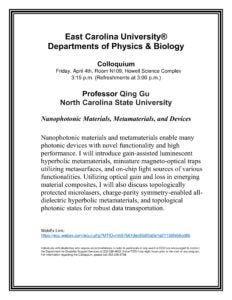
18 March 2026 — This Friday, March 20 at 3:15 p.m. will feature Dr. Jill Gallaher from the Moffitt Cancer Center, where she will present Controlling Metastatic Prostate Cancer with Evolutionary Treatment Strategies:

Drug resistance is an ongoing problem for maintaining a sustained response in the treatment of metastatic cancers. Metastatic prostate cancers almost inevitably occur after intense upfront treatment and progress into a more resistant, untreatable state. Evolutionary therapies embrace population heterogeneity to exploit competition and natural selection to steer cancer phenotypes. The goal of adaptive therapy is to maintain a population of treatment sensitive cells to suppress the outgrowth of treatment resistant cells by cycling treatment on and off adapted to individual patient dynamics. Here, I will discuss several ongoing adaptive therapy clinical trials and predictive mathematical models to improve strategies for metastatic prostate cancer control.

The presentation will be held in room N109 of the Howell Science Complex. Please join us via Webex if you are unable to attend in person.
Physics at ECU: Develop Your Potential

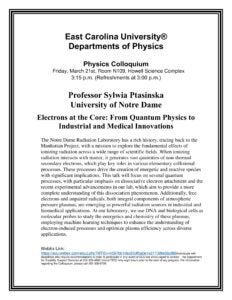
17 March 2026 — The Department of Physics at East Carolina University invites you to develop your potential:

Pirate Nation Gives 2026!


4 March 2026 — March 4 is Pirate Nation Gives, ECU’s annual spring fundraising campaign. We appreciate your support and participation in our work in the past and, today, on behalf of everyone in the ECU Physics program, we invite you to consider a gift of any amount to the Physics Priority Fund.

The fund was established several years ago to support undergraduate and graduate physics students. This year we plan to use the Physics Priority Fund to support undergraduate and graduate student recruiting. This means your donation to the Physics Priority Fund will help us bring new Physics majors to our programs.

Pirate Nation Gives begins at midnight on March 4.

Click here to donate. From $5 to $50 or $500 and up, your gift will make a difference.

Thank you in advance for your consideration!

Back to top